Molybdenum in Stainless Steel: Why Is It Added?
views, Updated: August 14, 2026 by aemmetal
Introduction
Molybdenum is added to stainless steel mainly to make it
more resistant to corrosion. It helps prevent pitting corrosion and crevice corrosion, especially in harsh environments with salt water, chlorides, or chemicals.
A common example is
316 stainless steel, which contains about 2–3% molybdenum. Compared with 304 stainless steel, 316 stainless steel offers better corrosion resistance and longer service life in demanding applications.
This article explains
why molybdenum is used in stainless steel, how it improves material performance, and where molybdenum-containing stainless steels are commonly used.
What Is Molybdenum and Why Is It Used in Stainless Steel?
Molybdenum is a
refractory metal with a very high melting point of
2,620°C. It is known for its excellent heat resistance, strength, and corrosion resistance.
When added to stainless steel, molybdenum mainly helps improve
corrosion resistance, especially in harsh environments containing salt water, chlorides, or chemicals. It also helps stainless steel maintain better strength at high temperatures.
Stainless steel gets its basic corrosion resistance from chromium, which forms a protective oxide layer on the surface. Molybdenum works together with chromium to make this protective layer more effective and helps reduce problems such as
pitting corrosion and crevice corrosion.
Because of these advantages, molybdenum-containing stainless steels are widely used in demanding industries, including
marine equipment, chemical processing, pharmaceutical manufacturing, oil and gas, and energy applications.
How Does Molybdenum Improve Stainless Steel Performance?
Molybdenum improves stainless steel performance in several important ways, but its most significant role is increasing
corrosion resistance. This is why molybdenum is widely used in stainless steel grades designed for harsh environments.
Improves Resistance to Pitting Corrosion
Pitting corrosion is a common problem when stainless steel is exposed to chloride environments, such as seawater, salt solutions, and chemical processing fluids. Small holes can form on the metal surface and gradually damage the material.
Molybdenum helps stainless steel resist this type of localized corrosion by making the protective surface layer more stable. As a result, stainless steel with molybdenum can maintain better performance in chloride-containing environments.
Improves Resistance to Crevice Corrosion
Crevice corrosion can occur in narrow gaps or areas with limited oxygen, such as joints, connections, and under deposits. Molybdenum helps reduce the risk of corrosion in these difficult areas.
This makes molybdenum-containing stainless steels suitable for equipment that must operate reliably for long periods, including heat exchangers, marine components, and chemical processing equipment.
Increases High-Temperature Strength
Besides improving corrosion resistance, molybdenum also helps stainless steel maintain strength at elevated temperatures. It improves properties such as creep resistance and high-temperature stability.
For this reason, some molybdenum-containing stainless steels are used in applications where both corrosion resistance and heat resistance are required.
Molybdenum vs Other Alloying Elements in Stainless Steel
Stainless steel performance depends on different alloying elements working together. Each element has a specific role, and molybdenum provides benefits that cannot be achieved by chromium or nickel alone.
Chromium: The Foundation of Corrosion Resistance
Chromium is the most important element in stainless steel because it creates a thin protective oxide layer on the surface. This passive layer helps prevent general corrosion and gives stainless steel its basic corrosion resistance.
However, chromium alone cannot fully protect stainless steel in harsh environments, especially those containing chlorides, such as seawater and salt solutions.
Nickel: Improves Structure and Toughness
Nickel helps maintain the stable austenitic structure of stainless steel. It improves toughness, ductility, and performance at low temperatures.
Nickel is especially important in common stainless steel grades such as 304 and 316, where it helps provide good mechanical properties and ease of fabrication.
Molybdenum: Provides Extra Corrosion Protection
Molybdenum plays a different role from chromium and nickel. Its main advantage is improving resistance to
localized corrosion, especially pitting corrosion and crevice corrosion.
Molybdenum works together with chromium to strengthen the protective effect of the surface layer. This makes molybdenum-containing stainless steels more suitable for aggressive environments with chlorides, chemicals, and high temperatures.
For example:
|
Element |
Main Function in Stainless Steel |
|
Chromium (Cr) |
Provides basic corrosion resistance |
|
Nickel (Ni) |
Improves toughness and structural stability |
|
Molybdenum (Mo) |
Enhances pitting and crevice corrosion resistance |
The combination of chromium, nickel, and molybdenum creates stainless steels with better overall performance. This is why grades such as
316 stainless steel are widely used when higher corrosion resistance is required compared with standard 304 stainless steel.
Why Does 316 Stainless Steel Contain Molybdenum?
316 stainless steel is one of the most common stainless steels containing molybdenum. The main reason for adding molybdenum is to achieve
better corrosion resistance than 304 stainless steel, especially in environments with salt, chlorides, and chemicals.
The typical composition difference is:
|
Stainless Steel Grade |
Molybdenum Content |
Main Feature |
|
304 Stainless Steel |
No molybdenum |
Good general corrosion resistance |
|
316 Stainless Steel |
About 2–3% molybdenum |
Better resistance to chloride and chemical corrosion |
|
317 Stainless Steel |
Higher molybdenum content |
Improved corrosion resistance for more aggressive environments |
The addition of molybdenum makes 316 stainless steel a better choice for applications where 304 stainless steel may experience corrosion problems. For example, equipment exposed to seawater, salt spray, or chemical solutions often uses 316 stainless steel because of its improved durability.
This is why 316 stainless steel is widely used in industries such as
marine engineering, chemical processing, food processing, pharmaceuticals, and medical equipment. Molybdenum gives 316 stainless steel the extra protection needed for long-term performance in challenging environments.
Common Molybdenum-Containing Stainless Steel Grades
Different stainless steel grades contain different amounts of molybdenum depending on their intended applications. Higher molybdenum content generally provides better resistance to corrosion, especially in harsh chemical and chloride environments.
316 and 316L Stainless Steel
316 and 316L stainless steel are the most widely used molybdenum-containing stainless steels. They usually contain about
2–3% molybdenum, which improves resistance to pitting and crevice corrosion.
316L is a low-carbon version of 316 stainless steel. The lower carbon content helps reduce the risk of corrosion after welding, making it suitable for welded structures and equipment.
Common applications include:
· Marine equipment
· Chemical processing equipment
· Pharmaceutical systems
· Food processing machinery
· Heat exchangers
317 Stainless Steel
317 stainless steel contains more molybdenum than 316 stainless steel, providing better corrosion resistance in more aggressive environments.
It is often selected for applications involving stronger chemicals, acids, and industrial processing conditions.
Common applications include:
· Chemical processing plants
· Pulp and paper equipment
· Industrial tanks and piping systems
904L Stainless Steel
904L stainless steel contains a higher amount of molybdenum, along with higher nickel and chromium content. This combination provides excellent resistance to severe corrosion environments.
It is commonly used where standard stainless steels may not provide enough protection.
Common applications include:
· Chemical processing equipment
· Offshore applications
· High-corrosion industrial environments
By choosing the right molybdenum-containing stainless steel grade, engineers can balance
corrosion resistance, mechanical performance, cost, and service life for different operating conditions.
How Is Molybdenum Added to Stainless Steel?
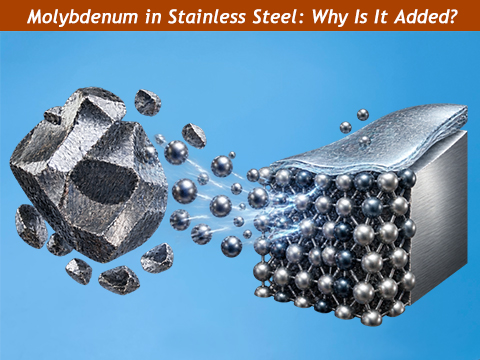
Molybdenum is usually added to stainless steel through
ferromolybdenum (FeMo), not as pure molybdenum metal. Ferromolybdenum is an alloy made mainly of iron and molybdenum, and it provides an efficient way to add molybdenum during steel production.
During the steelmaking process, ferromolybdenum is added into molten steel. The amount added is carefully controlled to achieve the required molybdenum content for different stainless steel grades.
The typical production route is:
Molybdenum ore → Molybdenum concentrate → Molybdenum oxide (MoO₃) → Ferromolybdenum → Molybdenum-containing stainless steel
For example,
316 stainless steel usually contains about 2–3% molybdenum. This small amount of molybdenum significantly improves resistance to pitting corrosion, crevice corrosion, and chemical environments.
It is also important to understand that
ferromolybdenum and high-purity molybdenum products serve different purposes. Ferromolybdenum is mainly used as a raw material for steel production, while high-purity molybdenum products, such as
molybdenum sheets, plates, rods, wires, and sputtering targets, are used in applications like high-temperature furnaces, semiconductor manufacturing, electronics, and coating systems.
By understanding the different forms of molybdenum, engineers can select the right material for stainless steel production or advanced industrial applications.
Conclusion
Molybdenum is a small but important addition to stainless steel. Its main benefit is improving
corrosion resistance, especially against pitting and crevice corrosion in harsh environments.
This is why stainless steels like
316 and 316L perform better than 304 stainless steel in applications involving salt water, chemicals, and industrial processes. The right amount of molybdenum helps stainless steel last longer and maintain reliable performance.
Although only a small percentage of molybdenum is added, it can make a big difference in how stainless steel performs. Understanding the role of molybdenum helps engineers choose the right material for demanding applications.