Tungsten Plate: Properties, Specifications, and Purchasing Guide
views, Updated: October 30, 2026 by aemmetal
What Is Tungsten Plate?
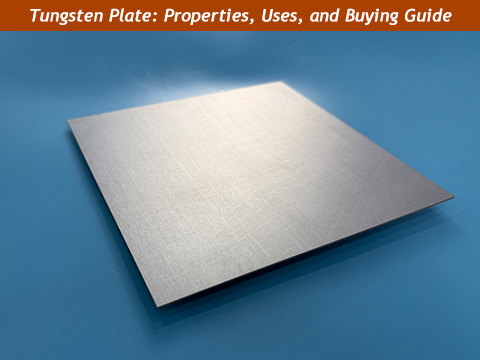
Tungsten plate is a flat metal product used directly or machined into components. Its high melting point and high density make it useful for furnace parts, radiation shielding, and other specialized applications. It can also serve as material for producing sputtering targets.
This guide focuses on
pure, or unalloyed, tungsten plate. Before purchasing, confirm both the material composition and the dimensions you need.
Pure Tungsten Plate vs. Tungsten Alloy Plate
Pure tungsten plate contains tungsten with small amounts of residual impurities. Commercial grades are commonly available with a minimum tungsten content of 99.95%, while higher-purity options are available for applications with stricter contamination limits.
Tungsten heavy alloy plate contains intentionally added metals, such as nickel and iron or nickel and copper. These additions change the material’s properties, including its machinability and mechanical behavior. Pure tungsten and tungsten heavy alloy should therefore be specified separately.
Tungsten carbide is another distinct material. It contains tungsten chemically combined with carbon and should not be confused with tungsten metal plate.
Tungsten Plate vs. Tungsten Sheet and Foil
Plate, sheet, and foil are all flat tungsten products. Plate generally refers to thicker material, sheet to thinner material, and foil to very thin material.
However, suppliers do not always use the same thickness boundaries. A product described as “plate” in one catalog may be listed as “sheet” in another. Check the applicable standard and actual dimensions instead of relying on the product name alone.
When requesting a quotation from a
tungsten plate supplier, state the material grade, thickness, width, and length. Include the required tolerances so the supplier can quote against clear, measurable requirements.
What Are the Main Properties of Tungsten Plate?
Tungsten plate combines heat resistance, high density, and low thermal expansion. Understanding these properties helps you decide whether it suits your application and which requirements to include in your order.
High Melting Point and Low Vapor Pressure
Tungsten has the highest melting point of any metal, at approximately
3,420°C. Its low vapor pressure also helps limit material loss through evaporation at high temperatures. These properties make it useful for furnace components and vacuum equipment.
The allowable operating temperature depends on more than melting point. The surrounding atmosphere, mechanical load, and heating cycle also matter. Include these conditions when discussing your application with the supplier.
High Density
Pure tungsten has a density of approximately
19.3 g/cm³ at room temperature. This means a relatively small component can contain considerable mass. Tungsten’s density also contributes to its use in radiation shielding.
Confirm the supplied plate’s density when it is important to your design. For shielding components, the required thickness also depends on the radiation type, energy, and shielding target.
Thermal Conductivity and Low Thermal Expansion
Tungsten conducts heat well and expands relatively little as its temperature rises. These properties are useful for components that transfer heat or need to limit dimensional changes during heating.
For precision parts, tell the supplier the operating temperature and required dimensions. Room-temperature measurements alone may not describe how the component will fit or perform during use.
Brittleness and Oxidation Limits
Pure tungsten can be brittle at room temperature. Cutting, drilling, and bending require suitable processing methods to control cracking and edge damage. Share your machining or forming plans before purchasing the plate.
Tungsten also oxidizes when heated in air, which limits its use in exposed high-temperature environments. For furnace applications, specify whether the plate will operate in vacuum, a protective gas, or air so the supplier can assess its suitability.
What Is Tungsten Plate Used For?
Tungsten plate is used to make furnace components, semiconductor equipment parts, sputtering targets, and radiation shields. Each application places different demands on the material, so the purchase specification should reflect how the finished component will be used.
High-Temperature Furnace Components
Tungsten plate can be machined into sintering base plates, supports, and fixtures for high-temperature furnaces. Tungsten flat products are also used for heat shields and heating components, with the thickness and shape chosen to suit the furnace design.
For a supporting plate, check the load it must carry, the required flatness, and how it fits into the assembly. Operating temperature, furnace atmosphere, and repeated heating and cooling also influence material suitability. Specify whether you need a blank for further machining or a finished component ready for installation.
Semiconductor and Thin-Film Equipment
Tungsten plate is used to produce arc-chamber parts for ion implantation equipment and other components exposed to high temperatures. High-purity tungsten flat products can also be processed into sputtering targets for thin-film deposition.
The material requirements depend on the process. For equipment parts, dimensions, surface condition, and contamination limits may be important. For sputtering targets, specify the required purity, impurity limits, density, and finished geometry. Confirm whether the quotation covers plate stock, a machined target, or a complete target assembly.
Radiation Shielding and Specialized Components
Tungsten plate is used as radiation shielding in medical imaging equipment. Its high density makes it useful where the design requires shielding within a limited space.
For these projects, identify whether the drawing requires pure tungsten or tungsten heavy alloy. The materials have different compositions and processing characteristics, so any substitution needs a technical review.
Provide the specified material density, plate thickness, and finished dimensions. Include tolerances for holes, slots, and mounting features where needed. These details help the supplier quote material that can be manufactured and inspected against the shielding design.
How Is Tungsten Plate Manufactured and Processed?
How tungsten plate is made affects its dimensions, surface quality, and behavior during machining. When purchasing, decide whether you need stock for further processing or a finished plate made to your drawing.
Pressing, Sintering, and Rolling
A common production process starts with tungsten powder. The powder is pressed into a compact, then heated to bond the particles together. This heating step is called
sintering.
The resulting block, called a billet, is rolled into plate. Each pass through the rolls reduces its thickness. Further rolling, heat treatment, and finishing help achieve the required dimensions and material properties.
Rolling Control and Process Optimization
Tungsten can crack or separate into layers during processing. Manufacturers must control the heating temperature, the time the material stays hot, and the thickness reduction in each rolling pass. These settings affect the plate’s grain structure and mechanical properties.
The rolling direction also matters.
Cross rolling involves turning the plate between selected passes. This changes the direction of deformation and can affect how the material behaves in different directions. The suitable rolling method depends on the starting material and the intended application.
At
AEM Metal, we coordinate rolling, heat treatment, levelling, and machining to meet the agreed thickness, material condition, and surface requirements. Our optimization work aims to limit processing defects and improve production consistency.
If your application requires a specific grain structure or mechanical property, include it in your inquiry. Agree with the supplier on how that requirement will be tested.
Cutting, Grinding, and Custom Machining
Tungsten plate can be milled, drilled, and ground into finished components. Because tungsten is hard and sensitive to cracking, these operations require suitable tools and controlled processing conditions. Grinding is often used for final shaping and surface finishing.
For custom parts, provide a drawing with the finished dimensions, tolerances, holes, profiles, and edge details. State whether you need a machining blank or a finished component.
If you will machine the plate after delivery, allow extra material for cutting, grinding, and surface cleanup. Agree on this
machining allowance before ordering, and include it in the stock dimensions.
Which Tungsten Plate Grade, Purity, and Standard Do You Need?
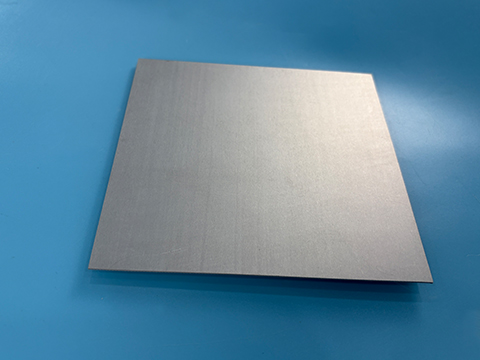
Before comparing quotations, define the material requirements. A clear specification helps suppliers quote the right tungsten plate and gives your inspection team a basis for accepting the delivery.
Specify Purity and Important Impurity Limits
State the material grade and minimum tungsten content in your inquiry. Suppliers offer purity levels such as
99.95%, 99.99%, and 99.999%, depending on the product and application. Confirm availability for your required plate dimensions.
Purity alone does not describe the full chemical composition. Two plates with the same stated tungsten content may have different impurity limits.
If your application limits elements such as carbon, oxygen, iron, or nickel, list those limits separately. Also ask how the supplier calculates purity and which elements are included. This is particularly useful when comparing high-purity material from different suppliers.
Confirm the Applicable Product Standard
Include the required standard and edition in your purchase specification. Examples include:
·
ASTM B760-07(2023): Covers wrought unalloyed tungsten plate, sheet, and foil, including chemical composition, supply condition, and dimensional requirements.
·
GB/T 3875-2017: China’s national standard for tungsten flat products, listed as current in the official standards database.
Review the requirements before accepting an alternative standard. The two specifications should not be assumed equivalent.
For custom plate, attach a drawing with its revision number and units. If the drawing and product standard set different requirements, agree on which takes priority before ordering.
Request Material Certification and Traceability
Ask for a material certificate linked to the batch you receive. It should identify the material and report the chemical results required by your order.
Confirm whether those results come from the powder batch, billet, or finished plate, and whether that testing scope meets your specification.
Request dimensional, flatness, surface-roughness, or mechanical test reports separately when needed. Agree on the required documents before production so their scope is included in the quotation.
How Do You Specify Tungsten Plate Sizes and Thickness Tolerances?
State the required size as
thickness × width × length, with units and tolerances clearly defined.
AEM Tungsten Plate Specifications
AEM lists the following specifications for high-precision tungsten plate:
|
Item |
Published specification |
|
Thickness |
1.0–42.0 mm |
|
Width |
30–450 mm |
|
Length |
Up to 500 mm |
|
Size tolerance |
±0.025 mm |
|
Standards |
GB/T 3875 and ASTM B760 |
Confirm the available size combination and which dimensions the tolerance covers before ordering.
Thickness Tolerance
Thickness tolerance defines the acceptable variation from the ordered thickness. For example, an agreed thickness of
5.00 ±0.025 mm allows measurements from
4.975 to 5.025 mm.
Specify flatness and parallelism separately, as thickness tolerance does not establish either requirement.
Machining Allowance
If the plate needs further machining, allow extra material for cutting, grinding, and surface cleanup. Clearly distinguish the ordered stock dimensions from the finished-part dimensions, and agree on the allowance with your supplier and machining team.
How Should You Specify Tungsten Plate Flatness?
Flatness matters when tungsten plate must sit evenly against another component or provide a stable mounting surface. State a measurable limit and agree on how it will be inspected.
Flatness, Parallelism, and Squareness
These requirements control different features:
|
Requirement |
What it controls |
|
Flatness |
How closely one surface matches a perfectly flat plane |
|
Parallelism |
A surface’s orientation relative to a specified reference surface |
|
Squareness |
The right-angle relationship between specified edges or faces |
Flatness controls an individual surface without using a reference surface, or datum. Parallelism requires a datum.
AEM lists a
squareness value of 0.025 mm. Define the controlled features and inspection method on the drawing. This value does not establish a flatness tolerance.
Standard Limits vs. Drawing Requirements
Some mill-product specifications express flatness deviation as a percentage. A precision drawing may specify geometric flatness in millimetres. These limits can use different definitions and measurement methods, so confirm the basis before comparing them.
Identify the applicable product standard and any additional drawing requirement. State which face is controlled and whether the limit applies across the whole plate or a defined area.
Flatness Inspection and Acceptance
Agree on how the plate will be supported during measurement and whether it will be measured without clamping. Clamping can change the plate’s shape and affect the result.
Also define the measurement method, surface coverage, and required inspection report. Clear inspection conditions help the supplier and receiving team assess the plate consistently.
What Affects Tungsten Plate Price and Lead Time?
At AEM, we prepare tungsten plate quotations based on your material requirements, dimensions, quantity, and processing needs. Providing a complete specification helps us give you a clear price and delivery schedule.
Material, Dimensions, and Quantity
Tell us the required grade, purity, thickness, width, length, and quantity. We use these details to assess material needs and suitable supply options.
If your dimensions are flexible, let us know. We can review whether an available stock size or a custom blank better suits your machining plan.
Processing and Inspection
Your quotation also depends on the cutting, grinding, machining, and heat treatment required.
Include your dimensional tolerances, flatness, surface finish, and inspection requirements in the inquiry. This helps us account for the necessary work and clarify which certificates and reports are included.
Stock Availability and Delivery
We confirm availability and production requirements during quotation. Custom dimensions, additional finishing, and special testing can affect the time needed before dispatch.
Share your required arrival date and delivery location so we can discuss production timing and shipping options.
Conclusion
Tungsten plate is valued for its high density and ability to perform at high temperatures. These properties make it useful in applications ranging from furnace components to semiconductor equipment and radiation shielding.
Each application uses the material differently. Understanding both the benefits and limitations of tungsten helps buyers choose a plate that fits the job and can be processed as intended.
If you need tungsten plate for your application, contact AEM Metal to discuss your requirements or request a quotation.