ASTM B760 Tungsten Plate, Sheet, and Foil: Standard Specification Guide
views, Updated: June 16, 2026 by aemmetal
1. Overview of ASTM B760 Standard
ASTM B760 is the standard specification that defines requirements for
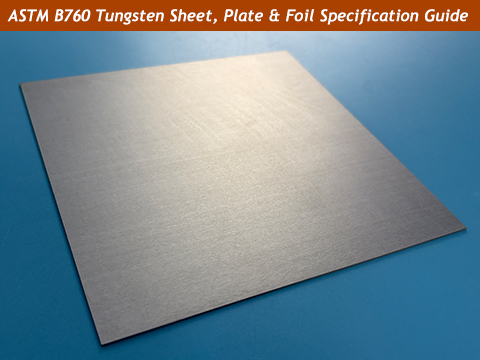
wrought unalloyed tungsten plate, sheet, and foil. It establishes the technical and quality criteria used to ensure that tungsten flat products meet consistent performance expectations in demanding industrial applications.
The scope of ASTM B760 is limited specifically to
tungsten flat products, including:
· Tungsten plate
· Tungsten sheet
· Tungsten foil
These materials are typically produced for use in environments where extremely high temperature resistance, dimensional stability, and material purity are critical.
From a procurement and engineering standpoint, ASTM B760 serves as a
reference standard for material consistency and quality assurance. It helps ensure that tungsten flat products delivered by manufacturers meet defined expectations in terms of chemical composition, processing condition, and dimensional accuracy.
In industrial supply chains—particularly in sectors such as semiconductors, vacuum furnace systems, aerospace, and high-temperature processing—ASTM B760 provides a
common technical baseline between material producers and end users. This reduces uncertainty in material selection and supports reliable performance in critical applications.
For suppliers like
AEM Metal, compliance with ASTM B760 ensures that tungsten plate, sheet, and foil products can be reliably used in applications where material failure is not an option, and where consistency from batch to batch is essential.
2. Scope and Material Definition
ASTM B760 defines the requirements for
wrought unalloyed tungsten flat products, specifically used in high-temperature, vacuum, and precision industrial applications. The standard focuses on ensuring consistent material classification, processing quality, and dimensional expectations for engineering and procurement use.
2.1 Covered Materials, Forms, and Thickness Classification
ASTM B760 applies exclusively to
unalloyed tungsten processed into flat product forms. These materials are typically produced via powder metallurgy or vacuum arc casting, followed by rolling or forging into final geometry.
The standard covers three primary product types:
·
Tungsten Foil: thickness
less than 0.005 in. (0.13 mm)
·
Tungsten Sheet: thickness
0.005 in. (0.13 mm) to 0.187 in. (4.75 mm)
·
Tungsten Plate: thickness
0.187 in. (4.75 mm) and above
This thickness-based classification is essential for ensuring correct material selection, as mechanical properties, formability, and end-use performance vary significantly across these ranges.
2.2 Workmanship, Finish, and Surface Condition
ASTM B760 requires tungsten flat products to be manufactured with a high level of workmanship and integrity. Materials must be free from injurious external or internal defects that could interfere with their intended application performance.
Depending on manufacturing route and customer requirements,
tungsten products may be supplied in
different surface conditions, including:
· As-rolled
· As-cleaned
· As-machined
· As-ground
These finish conditions provide flexibility for downstream processing while maintaining compliance with ASTM B760 requirements.
3. Manufacturing Process of ASTM B760 Tungsten (Powder Metallurgy Route)
ASTM B760 tungsten plate, sheet, and foil are manufactured primarily via a
powder metallurgy (PM) route, which is the most established industrial process for tungsten due to its extremely high melting point and limited feasibility of conventional melting-based processing.
3.1 Powder Metallurgy Production Route
The production of ASTM B760 tungsten flat products is typically carried out through the following controlled stages:
1. Powder purificationTungsten ore is chemically refined into
high-purity tungsten powder (≥99.95%), with strict control of interstitial and metallic impurities such as oxygen, carbon, and iron. This step is critical to ensure downstream mechanical and thermal performance.
2. Compaction and high-temperature sinteringThe tungsten powder is pressed into billets and then sintered at approximately
2000°C, achieving high densification and metallurgical bonding between particles. This stage establishes the structural integrity of the semi-finished material.
3. Thermo-mechanical rolling processSintered billets are progressively reduced through a combination of hot, warm, and cold rolling. This controlled deformation process enables:
· Thickness reduction to final specification
· Microstructural refinement
· Improvement of dimensional stability and surface quality
3.2 Dimensional Precision and Surface Quality Requirements
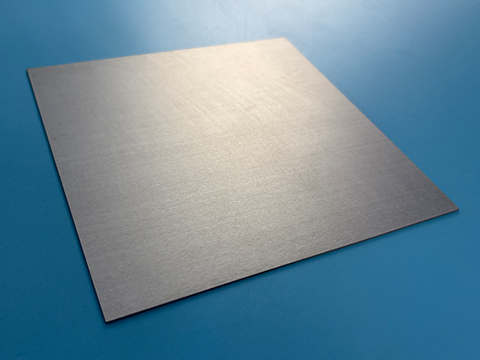
After rolling, ASTM B760 tungsten flat products are processed and controlled to meet stringent dimensional and surface specifications:
High Precision Tungsten Sheet (ASTM B760)
· Thickness range:
0.1 – 0.9 mm
· Thickness tolerance:
±0.013 mm
· Flatness:
≤ 0.025 mm
· Surface roughness:
Ra ≤ 0.8
High Precision Tungsten Plate
· Thickness range:
1.0 – 42.0 mm
· Size tolerance:
±0.025 mm
· Squareness:
0.025 mm
· Surface roughness:
Ra ≤ 0.8
3.3 Process Outcome and Material Characteristics
The powder metallurgy-based route ensures ASTM B760 tungsten products achieve a balanced combination of:
· High densification and structural uniformity
· Stable mechanical performance under thermal stress
· Tight dimensional tolerances suitable for precision engineering
· Controlled surface finish for vacuum and high-purity environments
These attributes make ASTM B760 tungsten plate, sheet, and foil suitable for critical applications in vacuum systems, semiconductor manufacturing, medical imaging equipment, electronics, and high-temperature processing technologies.
4. Chemical Composition Control of ASTM B760 Tungsten
ASTM B760 defines strict chemical composition requirements for unalloyed tungsten flat products to ensure stable performance in high-temperature, vacuum, and precision engineering applications. The specification focuses on controlling key impurity elements that directly affect material purity, ductility, and thermal stability.
4.1 Chemical Composition Limits & Check Analysis
|
Element |
ASTM B760 Maximum (wt%) |
Permissible Variation in Check Analysis |
|
Carbon (C) |
≤ 0.010 |
±0.002 |
|
Oxygen (O) |
≤ 0.010 |
+10% (relative) |
|
Nitrogen (N) |
≤ 0.010 |
+0.0005 |
|
Iron (Fe) |
≤ 0.010 |
+0.001 |
|
Nickel (Ni) |
≤ 0.010 |
+0.001 |
|
Silicon (Si) |
≤ 0.010 |
+0.001 |
These limits define both the
nominal chemical requirements and the allowable analytical variation during inspection. They ensure consistency between production batches while accounting for standard laboratory and sampling tolerances.
4.2 Engineering Significance of Chemical Control
Maintaining strict control over impurity elements is essential for achieving stable performance in tungsten flat products. Key benefits include:
· Stable deformation behavior during rolling and forming processes
· Reduced risk of embrittlement under thermal cycling conditions
· Improved vacuum compatibility with low outgassing characteristics
· Consistent microstructural stability in high-temperature environments
In critical applications such as
vacuum systems, semiconductor equipment, and high-temperature processing technologies, chemical composition stability is a primary factor governing long-term material reliability.
5. Applications of ASTM B760 Tungsten Flat Products
ASTM B760 tungsten plate, sheet, and foil are widely used in industries where
extreme temperature resistance, vacuum stability, and dimensional reliability are critical. Due to its high density, excellent thermal stability, and resistance to deformation, tungsten serves as a key functional material in advanced engineering systems.
5.1 Semiconductor and Electronics Industry
ASTM B760 tungsten is extensively used in semiconductor manufacturing due to its stability in high-temperature and vacuum environments.
Typical applications include:
· Thermal shielding components
· Evaporation boats and deposition elements
· Heat-resistant structural parts in vacuum chambers
Its low vapor pressure and high thermal stability make it suitable for ultra-clean processing environments.
5.2 Vacuum and High-Temperature Furnace Systems
Tungsten flat products are widely used in vacuum furnace and thermal processing equipment where conventional metals cannot maintain structural integrity.
Applications include:
· Heating elements and shields
· Furnace liners and structural supports
· High-temperature fixtures and carriers
The material’s resistance to deformation at elevated temperatures ensures long service life under cyclic heating conditions.
5.3 Medical and Imaging Technology
In medical systems, tungsten is valued for its density and radiation shielding capability.
Common uses include:
· CT imaging system components
· Radiation shielding plates
· Precision collimation parts
Its stable attenuation performance makes it suitable for compact and high-accuracy imaging systems.
5.4 Aerospace and High-Temperature Engineering
In aerospace and defense-related applications, ASTM B760 tungsten is used where both thermal resistance and structural reliability are required.
Applications include:
· High-temperature structural components
· Thermal protection and shielding elements
· Specialized engine or test system parts
5.5 Vacuum Coating and Precision Equipment
Tungsten sheet and foil are also used in vacuum coating and precision equipment industries due to their stability and surface performance.
Applications include:
· Vacuum coating evaporation components
· Precision thermal carriers
· Functional parts in high-vacuum deposition systems
5.6 Engineering Summary
Across all industries, ASTM B760 tungsten flat products are selected for applications where
material failure is not acceptable under extreme conditions. Their combination of thermal stability, density, and structural reliability makes them a foundational material in advanced manufacturing and high-performance engineering systems.
Conclusion
ASTM B760 sets the minimum requirements for tungsten plate, sheet, and foil. It defines what the material must be in order to perform reliably in high-temperature, vacuum, and precision applications.
In real use, compliance with the standard is only the starting point. The actual performance depends on how consistently the material is manufactured and controlled across the entire process.
From an engineering perspective, the key takeaway is simple:ASTM B760 defines what tungsten must be; advanced manufacturing defines how well it performs.
This difference is especially important in advanced applications where stability and repeatability matter more than basic compliance.
AEM Metal provides high-quality
custom tungsten solutions that go beyond standard ASTM requirements, offering improved consistency, precision, and application-specific performance for demanding industrial use.
If you have custom requirements, please feel free to
contact us.